$329. That's what Apple's repair estimator charged for a new front screen on an iPhone 17 Pro, as 9to5Mac reported on 12 September 2025, and the whole question turns on it. So is AppleCare worth it? Add two years of AppleCare+ with Theft and Loss to the fee Apple charges per crack, and set that beside the repair bill. One cracked screen is roughly where the lines cross.
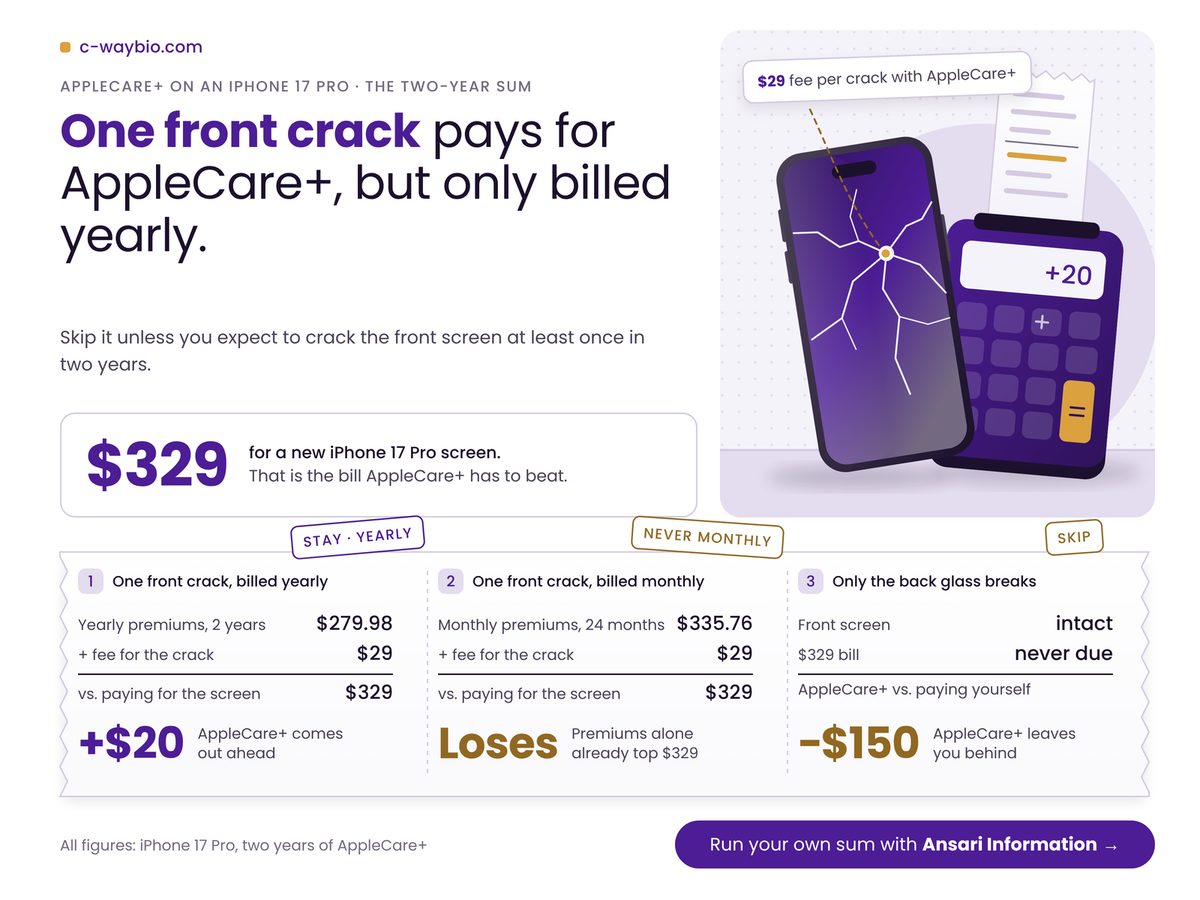
Key Takeaways: skip AppleCare+ on an iPhone 17 Pro unless you expect to crack the front screen at least once in two years, and never pay for it monthly.
- Billed yearly, one front-screen crack leaves you about $20 ahead after 24 months.
- Billed monthly, that same crack becomes a loss of about $36.
- A crack in the back glass alone never repays the plan.
- Losing the phone is where the cover earns real money.
Is AppleCare worth it if you crack one screen?
Yes, but barely: on yearly billing an iPhone 17 Pro owner who cracks one front screen in two years comes out about $20 ahead, and anyone who cracks nothing has paid $279.98 for reassurance.
Apple Legal's AppleCare fees page, as of October 2026, charges $29 for outer display or back glass damage, and a separate fee applies to each repair. Apple's New York price disclosure for AppleCare+ with Theft and Loss, dated September 2025, lists the iPhone 17 Pro at $13.99 a month, $139.99 a year or $269 for a 24-month fixed term. Same phone, same crack, three different answers.
Worked example: assume an iPhone 17 Pro, AppleCare+ with Theft and Loss billed yearly, 24 months of ownership and one front-screen crack. Premiums are 2 × $139.99 = $279.98. Add the crack fee: $308.98. Without the plan you pay the $329 repair, so the plan wins by $20.02. Billed monthly, premiums become 24 × $13.99 = $335.76; with the fee that's $364.76, and the plan now loses by $35.76.
Twenty dollars is a thin margin for peace of mind. We'd judge it like the payback years on swapping a window AC for a mini split: it earns its place only if payback lands inside the time you own it. Monthly billing is the trap of paying a credit card annual fee to chase its waiver: a cost sliced small stops looking like one.
Four numbers frame every case below. Apple's AppleCare page, read in October 2026, says most Apple products get one year of hardware coverage under the limited warranty, and that plans include unlimited incidents of accidental damage, each with its fee. The fourth card is our own arithmetic.
Free Apple Hardware Cover
12 months
Defects already free in year one
Screen or Back Glass Fee
$29
What each crack still costs you
Accident Claims Allowed
Unlimited
Repeat droppers gain the most
Crack Odds to Break Even
93%
Derived: yearly plan, near-certain crack
The free first year matters: any defect then is Apple's problem anyway, so year-one premiums buy only accident and theft cover.
On yearly billing, a 17 Pro owner needs better than nine-in-ten odds of cracking the front glass inside two years before AppleCare+ pays for itself.
That odds figure is one division: $279.98 of premiums over the $300 a crack saves after the fee.
What two years of cover cost, crack by crack
Over 24 months on an iPhone 17 Pro, AppleCare+ only finishes ahead when a front screen breaks, and how you pay moves the result by more than the plan's entire margin on one crack.
Find your row by what breaks in two years, then read across at how you pay. Each cell is what the plan leaves you ahead (+) or behind (−) against Apple's reported repair prices, including $159 for back glass.
| What breaks | Monthly | Yearly | Upfront |
|---|---|---|---|
| Nothing | −$336 | −$280 | −$269 |
| Back glass | −$206 | −$150 | −$139 |
| One screen | −$36 | +$20 | +$31 |
| Two screens | +$264 | +$320 | +$331 |
The shaded cell, one front-screen crack on yearly billing, is the base case at +$20. One column left, monthly, flips it to −$36; one row up, back glass only, drops it to −$150. Now the one-minute check: divide your plan's two-year cost by $300 and compare it with your honest odds of cracking a front screen. Count the screens you broke on your last two phones first.
Pay monthly for a 17 Pro and one front-screen crack stops covering your premiums once you keep the phone 22 months. Derived by summing Apple's $13.99 monthly price against the $300 a crack saves after the fee.
Where the one-crack rule bends
The one-crack rule bends when the phone is lost outright, which the plan covers far more generously than a crack, and when several Apple devices could share one AppleCare One bill.
Apple Legal sets the theft and loss deductible at $149. A new iPhone 17 Pro started at $1,099 in the US, per Apple's September 2025 launch release, so one lost phone saves about $950. On our arithmetic, yearly premiums break even on loss alone if your odds of losing it within two years top roughly 29%. That bar sits far below the crack bar, and we think most buyers undervalue it.
We found no current, method-published US figure for how often owners crack a front screen, so your odds are yours to estimate (the honest grey area here). Weigh them like renewing versus porting a health insurance policy: by what you claimed, not what you fear.
Is AppleCare One cheaper than AppleCare+?
For one iPhone alone, no: AppleCare One Individual costs $19.99 a month for up to three products, so it beats a $13.99 iPhone plan only once a second or third device rides on it.
At $239.88 a year it costs $99.89 more than the yearly iPhone plan, so the extra devices must be ones you'd otherwise insure.
- Batteries: Apple's battery service page says the plan replaces it free once capacity drops below 80%. The reported $119 out-of-warranty price counts only if yours dips under that line within two years.
- Monthly billing: 24 payments cost $55.78 more than two yearly ones.
- Pro Max: its reported $379 screen puts yearly AppleCare+ $70.02 ahead after one crack.
Check each line against your own situation
- You cracked a front screen on one of your last two phones.
- You'll keep this iPhone a full 24 months or longer.
- You can pay yearly, or for the 24-month term, up front.
- No carrier or card plan already covers phone loss.
Our call: stay uninsured on an iPhone 17 Pro if you can't honestly see a front-screen crack coming within two years, and bank the premium yourself. Switch to AppleCare+, billed yearly, if you can, or if losing a phone is a real risk. This is wrong if Apple has cut its screen price since September 2025, so this week, before you buy, open Apple's repair estimator for your exact model and confirm the screen still costs more than your two-year plan plus the $29 fee.
How we checked this
We read Apple's AppleCare fees and deductibles page and its AppleCare plans page, both checked 23 October 2026, plus Apple's September 2025 price disclosure. Apple's iPhone repair pricing estimator did not load figures for us, so repair prices are 9to5Mac's September 2025 report of it. The worked example assumes an iPhone 17 Pro, yearly billing, 24 months and one front-screen crack. No product was tested hands-on for this article. Last verified: 23 October 2026.
Edited by Ansari, reviewed after publication. Spotted something out of date? Tell us and we will correct it.